Add your promotional text...

Crypto Is Changing Costume: Welcome to the Real Economy of Finance
A plain-language guide for business owners on blockchain, tokenization, and real-world assets
DIGITAL ASSETS
7/17/20266 min read
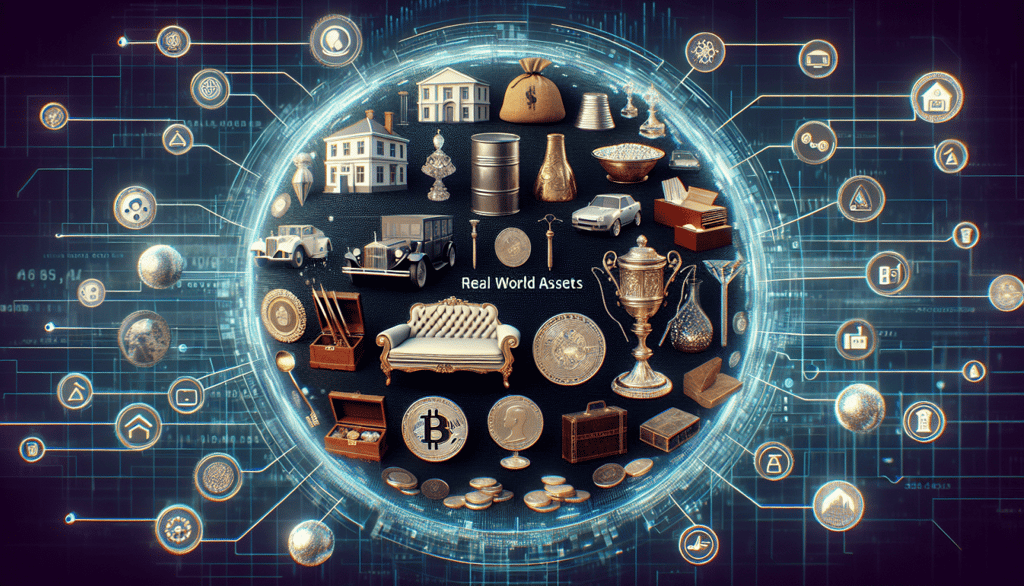
For years, blockchain was sold as a rebellion. The story went something like this: banks would become useless, Wall Street would crumble, and a new decentralized world would take over global finance.
That is not quite what is happening.
Instead, something more interesting — and more useful for business owners — is unfolding. Banks are not disappearing. They are quietly adopting the technology to become faster, cheaper, and more efficient. The buzzword behind this shift is tokenization, and it is worth understanding, even if you have never touched cryptocurrency in your life.
What Is Tokenization, in Plain Words?
Imagine you own a building, a bond, or shares in a company. Normally, buying, selling, or transferring ownership of these things involves paperwork, lawyers, banks, and delays — sometimes days.
Tokenization takes that same asset — a bond, a share, a piece of real estate, gold, even a private loan — and creates a digital “twin” of it on a blockchain. This digital version can be bought, sold, or transferred almost instantly, at any hour, with far fewer intermediaries.
Nothing changes about what the asset actually is. What changes is how easily and quickly it can move.
This Is No Longer a Niche Experiment
A few years ago, this idea lived mostly in crypto startups. Today, the biggest names in traditional finance are building it:
• BlackRock, the world's largest asset manager, launched a tokenized fund called BUIDL that invests in U.S. Treasury bonds directly on blockchain rails. It has grown to roughly $2.5 billion in assets.
• JPMorgan runs its own blockchain-based platform (known as Kinexys, formerly Onyx) to settle transactions between institutions faster and around the clock.
• Franklin Templeton has launched tokenized money market funds available to investors on-chain.
• Mastercard has been testing how tokenized assets and traditional payment networks can work together.
• The DTCC (which clears and settles the vast majority of U.S. securities trades) is piloting blockchain-based settlement for institutional markets.
These are not experiments run by small crypto teams anymore. These are the institutions that already run the world's financial plumbing, and they are rebuilding parts of it on blockchain.
What the Numbers Actually Look Like
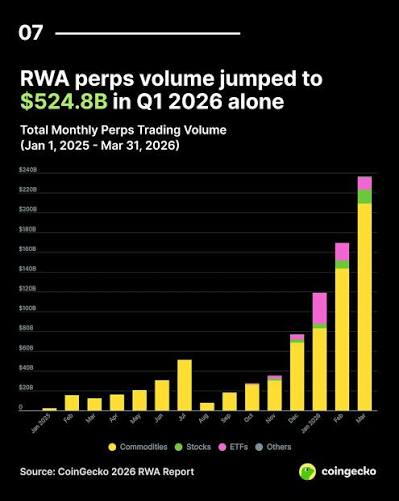
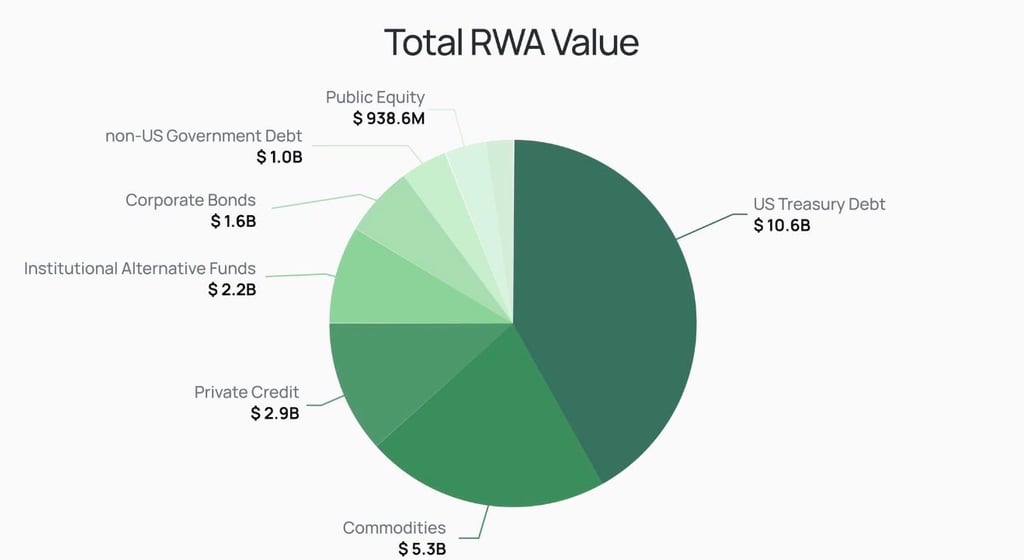
To put this in perspective, here is a snapshot of how real-world assets (“RWAs”) are currently distributed on public blockchains, based on data tracked by industry analysts:
• US Treasury Debt – $10.6 billion
• Commodities – $5.3 billion
• Private Credit – $2.9 billion
• Institutional Alternative Funds – $2.2 billion
• Corporate Bonds – $1.6 billion
• Non-US Government Debt – $1.0 billion
• Public Equity – $938.6 million
That adds up to roughly $24.5 billion in tokenized assets currently circulating on blockchain networks — and this figure has been growing several hundred percent per year since 2024. U.S. government debt alone makes up close to half of that total, which tells you something important: the first real-world assets being tokenized at scale are the safest, most liquid, most “boring” instruments in finance. That is not a coincidence. It is a sign that institutions are testing the technology where the stakes of getting it wrong are lowest, before expanding further.
Why This Matters Even If You Run a Small or Medium Business
You do not need to buy tokenized Treasury bonds to be affected by this shift. Here is why it matters for an SME owner:
1. Faster, cheaper settlement eventually trickles down.
When banks settle transactions instantly instead of over two or three days, the cost savings and speed improvements tend to filter into the broader financial system — including business loans, trade finance, and cross-border payments that SMEs rely on.
2. New financing tools may become available to smaller companies.
Tokenization also applies to private credit — loans made to companies. As this market grows on-chain, it could eventually make it easier for smaller and mid-sized businesses to access financing from a wider pool of investors, not just their local bank.
3. It signals where serious money is heading.
When BlackRock, JPMorgan, and the DTCC all move in the same direction, it is a strong signal that blockchain is no longer a speculative side project. It is becoming financial infrastructure — the kind of thing that eventually shows up in the tools banks offer businesses, the payment rails companies use, and the way assets are valued and traded.
Tokenization in Action: Real Examples Across Industries
Tokenization is not limited to bonds and Treasury bills. Companies across very different industries are already experimenting with it — often for reasons that have nothing to do with crypto speculation and everything to do with efficiency, financing, and trust.
Automotive: Toyota's Mobility Orchestration Network
Toyota offers one of the clearest examples outside pure finance. In August 2025, Toyota's Blockchain Lab published a framework called the Mobility Orchestration Network (MON), built on the Avalanche blockchain. The idea is to give every vehicle a verifiable digital identity — a kind of “digital twin” — that tracks its full lifecycle: ownership history, maintenance records, insurance status, and accident history, all in one tamper-proof ledger.
Once a vehicle has this digital identity, it can be tokenized. Toyota describes a “Fungibility Ladder”: a car starts as a unique digital token (like a fingerprint for that specific vehicle), can be bundled with other cars into an investable portfolio, and can eventually be turned into a fully tradable financial product. In practice, this could let logistics companies, taxi fleets, or car-sharing operators raise financing by packaging groups of vehicles into investment products — similar to how mortgages are bundled today, but for cars. Toyota is also exploring blockchain for supply-chain traceability, so a dealer or customer can verify that a spare part is a genuine Toyota component.
Real Estate: Fractional Ownership Goes Mainstream
Real estate has become one of the most active sectors for tokenization, precisely because property is expensive, illiquid, and full of paperwork.
• RealT, a US platform, has tokenized several hundred rental properties. Investors can buy a fractional share of a house for as little as $50 and receive their portion of the rental income directly, paid daily in digital dollars.
• Propy takes a different approach: instead of fractionalizing rental income, it records the property deed itself on blockchain, making the closing process faster and reducing fraud in the transfer of ownership. It has also handled tokenized sales of commercial buildings.
• RedSwan has brought large commercial property portfolios — including deals worth several hundred million dollars — onto blockchain rails, opening them up to a broader base of investors.
• The Aspen St. Regis Resort in Colorado was tokenized and made tradable on a regulated securities exchange, letting investors buy shares in a five-star hotel much like they would buy shares of a stock.
For an SME owner, the takeaway is not that you should buy tokenized property tomorrow — it's that the paperwork-heavy, slow-moving world of real estate transactions is being rebuilt to be faster and more accessible, which could eventually make commercial financing and property-backed lending more flexible.
Luxury Goods and Commodities: Proving What's Real
Not all tokenization is about splitting up ownership — some of it is about proving authenticity and origin.
• The Aura Blockchain Consortium, founded by LVMH, Prada, and Cartier, gives luxury brands a shared blockchain standard to prove a product is genuine, trace its supply chain from raw material to finished item, and simplify resale — a direct answer to the counterfeit problem that costs luxury brands billions each year.
• PAX Gold (Paxos) and Tether Gold each let investors own a token backed by one troy ounce of physical gold stored in an audited vault. Instead of paying for storage and insurance on a physical bar, the token can be transferred instantly, split into smaller amounts, and verified against a specific, serial-numbered gold bar.
Across all these examples — cars, buildings, gold, and luxury bags — the common thread is the same: take something physical and hard to move, and give it a digital layer that makes it easier to verify, finance, or trade.
The Bigger Picture
For a long time, the crypto market was mostly about speculation — buying digital tokens and hoping their price would rise. What is happening now is a different story: blockchain is being repositioned as infrastructure, quietly working in the background of banks, asset managers, and payment networks.
You probably will not notice it directly. Most SME owners will never open a crypto wallet to use it. But the systems you already depend on — banking, payments, financing — are likely to run a little faster and a little cheaper because of it in the coming years.
Understanding this shift now means being ready for it, rather than being surprised by it later.
© 2026 Yakara Strategy. All rights reserved.


YAKARA Strategy
Legal & Privacy