The electricity cost of the Bitcoin network is not random. It follows a strict mathematical logic, dictated by the fluctuations of the financial markets.
The Bitcoin network consumes a massive amount of energy, but its trajectory is neither random nor linear. Data reveals that the electricity cost of the leading cryptocurrency follows a precise data model: an asymmetric feedback loop, driven by market prices and immutable mathematical rules.
Behind Bitcoin's IT infrastructure lies a simple equation: total electricity expenditure adjusts to align with the overall revenue generated by miners. This mechanism creates a direct correlation between the token's financial value and the amount of megawatts consumed globally.
A Price-Driven Feedback Loop
When the price of Bitcoin rises, mining profitability skyrockets. Attracted by profits, miners worldwide bring new computing machines online. This massive deployment increases the overall power of the network (the hashrate), which mechanically drives up electricity consumption.
However, this relationship is asymmetrical. Data shows that during periods of rapid price increases, the rise in energy consumption is delayed. Miners must sell some of their assets to finance the purchase and delivery of new equipment. Conversely, when prices plummet, the reaction is immediate: obsolete or unprofitable machines are instantly shut down, causing a sharp drop in electricity demand.
The Mathematical Rigidity of the "Staircase" Effect
To regulate this industry, the Bitcoin protocol incorporates a self-adjusting tool: network difficulty. Every 2016 blocks (approximately every two weeks), the algorithm recalculates the complexity of the cryptographic puzzles to be solved. The goal is to maintain a constant production time of 10 minutes per block, regardless of the total connected computing power.
This bi-weekly adjustment creates a very clear staircase pattern in the data. The daily computing load and associated electricity costs increase in successive steps, stabilizing as the energy efficiency of the hardware improves.
The "Halving" and the floor price of electricity
The most critical breaking point in this model occurs every four years during the halving (the halving of the block reward). This event instantly halves miners' Bitcoin earnings. Overnight, the theoretical energy cost required to mine a single unit doubles, acting as a ruthless filter for the least efficient operators.
By aggregating this data, analysts observe that overall operating costs (dominated by electricity) eventually establish a floor price for electricity. Historically, when the price of Bitcoin falls to near this actual production cost, the market reaches its lowest point. Electricity no longer simply follows the price of Bitcoin; it sets the limit below which it cannot fall without threatening the very survival of the network.
Bitcoin's economic model shows that the cost of electricity production acts as a historical technical support during bear markets. This cost floor corresponds to the minimum electricity expenditure required to mine one Bitcoin with the most efficient hardware on the market.
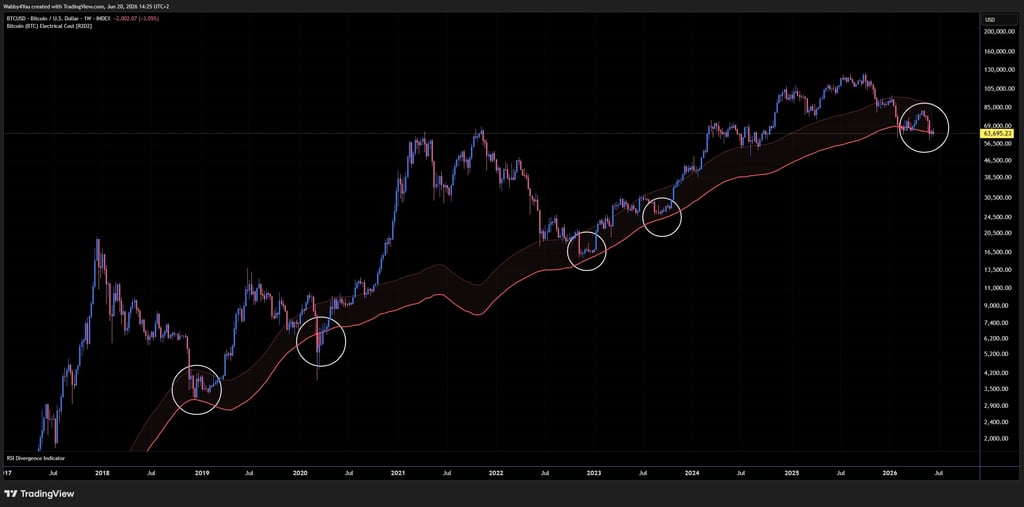
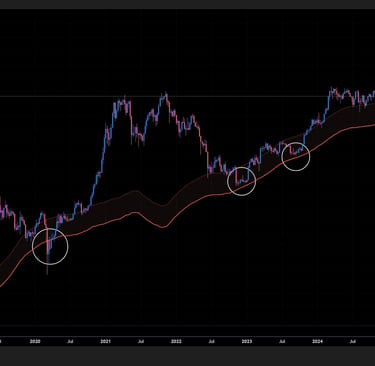
The chart above illustrates this temporal correlation. When the price of Bitcoin collapses to the point where it touches the electricity production cost curve, the market capitulates (inefficient miners cease operations), forming a cyclical historical low before initiating a new upward cycle.
Analysis of Key Chart Contact Points
December 2018 (the low at 3,200): After an 85% drop from its 2017 peak, Bitcoin reached its electricity cost curve. The market stagnated for a few weeks, weeding out unprofitable miners, before beginning a new upward trend.
November 2022 (the capitulation at 16,000): Following the collapse of several platforms, the price of Bitcoin plummeted to equal the average cost of electricity required for the latest generation of ASICs. This point of contact marked the exact bottom of the cycle.
The Halving Effect (the stair-step effect): Sudden spikes in the electricity cost curve represent halving events. By halving the block reward, the electricity cost per Bitcoin instantly doubles, forcing the market price to adjust upwards in the medium term to maintain network security.